Jin Hyun Park / Qual Exam Prep / Networking
Networking
Layers, protocols, and a handful of mechanisms you should be able to explain in one sentence each.
The OSI model
Seven layers, from the application down to the wire. Each layer has its own name for the unit of data it handles.
| Layer | Unit | What it does |
|---|---|---|
| 7. Application | Data (message) | The protocols programs use directly: HTTP, SMTP, DNS, and so on. |
| 6. Presentation | Data | Converts data from the sender's system-specific representation into a common form. Compression and encryption happen here. |
| 5. Session | Data | Opens, manages, and closes sessions between applications. |
| 4. Transport | Segment (TCP), datagram (UDP) | End-to-end reliability: flow control, splitting data into segments and reassembling it, error control. TCP keeps track of segments and retransmits any that are lost. |
| 3. Network | Packet | Forwards packets toward their destination, including routing through intermediate routers. IP lives here. |
| 2. Data link | Frame | Delivers frames between directly connected nodes. Ethernet and MAC addresses live here. |
| 1. Physical | Bit | Puts bits on the cable, fiber, or radio. |
Client–server vs. peer-to-peer
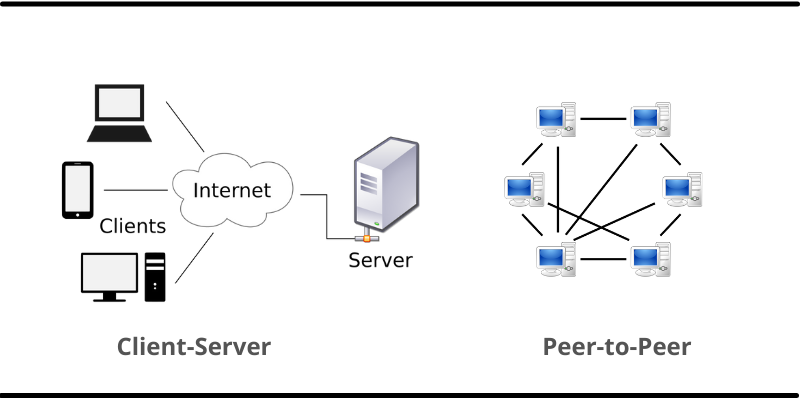
- In a client–server network, central servers hold the resources and respond to client requests. If the server goes down, the service is gone.
- In a peer-to-peer network, there is no center: every node can act as both client and server, and data can be located anywhere on any connected device.
CSMA/CD
- Carrier Sense Multiple Access with Collision Detection. It is the medium-access (MAC-layer) protocol used by classic shared Ethernet.
- Carrier sense: before sending, a station listens to the shared channel and waits until it is free.
- Collision detection: a station keeps listening while it transmits. If two stations start within one propagation delay of each other, their signals collide; each one aborts as soon as it notices, sends a short jam signal, and waits a random time before retrying.
- The random wait uses binary exponential backoff: after the k-th collision the station picks a wait from 0 to 2k − 1 slot times (capped at 10 doublings), and gives up after 16 attempts.
TCP timers
TCP uses four timers to keep a connection reliable.
- Retransmission timer: started whenever a segment is sent. If the acknowledgment does not arrive before the retransmission timeout (RTO) expires, the segment is sent again.
- Persistence timer: prevents a deadlock where the receiver advertised a zero window, later reopened it, but the "window open" message was lost. The sender periodically probes so it does not wait forever.
- Keep-alive timer: prevents an established but idle connection from sitting open indefinitely; if nothing is heard for a long time, a probe is sent and the connection is closed if there is no reply.
- Time-wait timer: the side that performs the active close waits 2 × MSL (twice the maximum segment lifetime) before fully closing. This lets it retransmit the final ACK if that ACK was lost, and ensures that delayed or duplicated segments from the old connection die out instead of confusing a new connection on the same ports.
Ethernet
- Uses packet switching: data is sent in frames rather than over a dedicated circuit.
- Frames have a maximum size (about 1500 bytes of payload).
- Classic shared Ethernet uses CSMA/CD to decide who may transmit.
- It is a bus with multiple masters: any station can initiate a transmission.
Address Resolution Protocol (ARP)
- Finds the hardware (MAC) address that corresponds to a given IP address on the local network.
- IP addresses are logical addresses assigned in software; MAC addresses are the physical addresses burned into the network interface. ARP is the bridge between the two: "who has IP 10.0.0.5? tell me your MAC."
- The ARP request is broadcast (destination MAC ff:ff:ff:ff:ff:ff) so every host on the LAN sees it; only the owner of that IP answers, with a unicast reply. Results are cached in an ARP table for a few minutes.
Parity bit
- An extra bit added to a group of bits so that errors introduced during transmission can be detected.
- With even parity, the parity bit is chosen so that the total number of 1s (including the parity bit) is even. If a single bit flips in transit, the count becomes odd and the receiver knows something went wrong.
- Examples with the parity bit added at the front:
- 0000000 (zero 1s) → 0 0000000
- 1010001 (three 1s) → 1 1010001
- 1101001 (four 1s) → 0 1101001
- 1111111 (seven 1s) → 1 1111111
- Parity catches any odd number of flipped bits, but not an even number.
Datagrams and fragmentation
- UDP hands each message to IP as a single datagram. It is IP (the network layer), not UDP, that fragments a datagram when it is larger than a link's MTU. In IPv4, routers along the way may fragment; in IPv6 only the sender does.
- The fragments are reassembled only by the IP layer at the final destination host, never by intermediate routers.
Round-trip time (RTT)
- The time from sending a packet until its reply comes back. The
pingcommand measures it by sending an ICMP echo request and timing the echo reply.
TCP three-way handshake
- Before any data is exchanged, TCP sets up a session so that both sides agree on initial sequence numbers and know the other is listening.
- The order is SYN (client asks to connect), SYN/ACK (server agrees and asks back), ACK (client confirms). After these three messages the connection is established.
Overview · Useful materials · Sample questions · Algorithms · Architecture · OS · Databases · Automata · AI / ML · Things to remember